Portugal Has Changed Its Nationality Law. Here’s What Everyone Is Trying to Understand.

Joana Torres Fernandes
Founding & Managing Partner
Head of Immigration & Nationality

Joana Loureiro Veríssimo
Lawyer
The recent amendment to the Portuguese Nationality Law has generated enormous uncertainty among foreign residents, investors, retirees and families connected to Portugal.
Over the last days alone, our Team has received hundreds of emails from concerned clients trying to understand whether they can still apply for Portuguese nationality, whether the new rules affect their specific situation, whether AIMA delays will be taken into account, and whether there is still anything they can do.
Some of the questions are highly technical.
Some are extremely practical.
Some are surprisingly emotional.
And some may sound simple, but reflect the genuine uncertainty many people are currently experiencing.
What is already clear is that Portugal has not simply increased nationality waiting periods.
The new law appears to reflect a broader shift in the philosophy underlying Portuguese nationality itself, with a much stronger emphasis on integration, cultural connection, civic knowledge, security considerations and demonstrable links to the Portuguese community.
Below are 30 of the real questions people are now asking.
30 Most Frequently Asked Questions About Portugal’s 2026 New Nationality Law
1. Has the Portuguese Nationality Law already changed?
Yes.
The amendment to the Portuguese Nationality Law was officially published on 18 May 2026 and entered into force on 19 May 2026.
This means the new rules are already legally in force.
2. What is the biggest change introduced by the new law?
The most significant change is the increase of the minimum legal residence period required for naturalisation.
Previously, most foreign nationals could apply for Portuguese nationality after 5 years of legal residence.
Under the new law:
- EU citizens and CPLP nationals now require 7 years of legal residence.
- Nationals of all other countries now require 10 years of legal residence.
3. Does the residence period still count from the date I first applied to AIMA?
This is one of the most sensitive and controversial questions arising from the reform.
The new wording of the law reinforces the importance of formally recognised legal residence for nationality purposes, referring to residence based on the applicant’s regularised situation under the applicable residence titles, visas or authorisations.
This means that applicants should not assume that the mere filing of an immigration application with AIMA will automatically count as legal residence for nationality purposes.
However, important practical and interpretative questions remain open, particularly in cases where applicants were affected by long administrative delays that were entirely outside their control.
This will likely become one of the most debated and potentially litigated issues arising from the reform.
4. I have already completed 5 years of residence. Am I safe?
Not necessarily.
The decisive issue is not simply whether you completed 5 years of residence.
The key factor is whether your nationality application was effectively submitted before the new law entered into force.
If the application was not submitted before the entry into force of the new law, the new residence periods may now be relevant to your case.
5. I had all my documents ready. Doesn’t that count?
No.
- Many clients had:
- passed the A2 exam;
- prepared documents;
- obtained translations;
- hired lawyers;
- or were preparing to submit.
Unfortunately, legally speaking, having the documents ready is not the same as having submitted the nationality application.
What matters is the formal submission of the application before the entry into force of the law.
6. My lawyer was preparing my file. Doesn’t that preserve the old rules?
No.
Preparation alone is not sufficient.
The application itself needed to have been formally submitted before the new law entered into force.
7. I already submitted my nationality application. Am I protected?
Applications already submitted before the entry into force of the new law should, in principle, continue to be analysed under the previous legal framework.
This is one of the most important protections for applicants who already had pending nationality procedures.
8. My AIMA process was delayed for years. Why am I being punished?
This is probably the most common question we are receiving.
Many residents waited years for:
- appointments;
- renewals;
- residence card issuance;
- or immigration approvals.
In many situations, those delays were entirely outside the applicant’s control.
However, the law currently in force does not create a clear automatic exception for applicants affected by AIMA delays.
This will likely become one of the most debated legal and political issues arising from the reform.
9. Does the waiting time before residence card issuance count?
At this stage, important practical questions remain unclear.
The law reinforces the relevance of legal residence and of a regularised status under the applicable residence framework.
However, the practical treatment of periods affected by administrative delays, including delays in appointments, approvals or card issuance, may still require further clarification through regulation, administrative practice or judicial interpretation.
The Portuguese Government still has 90 days from the publication of the law to publish the updated regulation implementing the recent amendments.
10. Does this affect Golden Visa holders?
Yes.
Golden Visa holders are also affected by the new nationality timelines.
Many investors understandably structured their expectations around the previous 5-year framework and are now reassessing their long-term strategy in Portugal.
However, each case should be analysed individually, particularly where there have been delays in approvals, renewals or card issuance.
11. But Portugal wanted foreign investment. Why change the rules?
This is another question we are hearing repeatedly.
Nationality policy is ultimately a political and legislative matter and Governments may alter the legal framework applicable to future applications.
That said, many investors understandably feel frustrated because they made substantial investments relying on a legal framework that remained stable for several years.
12. I already passed the A2 Portuguese exam. Was that pointless?
No.
Portuguese language knowledge remains extremely important.
In fact, the new law appears to reinforce integration-related requirements even further.
The A2 certificate may still be relevant, but applicants should now be aware that the law also refers to broader requirements connected to Portuguese culture, history, national symbols, civic knowledge and integration.
13. Wait… do I now need to know Portuguese history and national symbols?
Potentially yes.
The new law now expressly refers to:
- Portuguese culture;
- history;
- national symbols;
- rights and duties inherent to Portuguese nationality;
and the political organisation of the Portuguese State.
This is one of the clearest signs that the nationality process may become more focused on civic and cultural integration.
14. What exactly are “Portuguese national symbols”?
At this stage, the law does not define this expression in detail.
Clients have genuinely asked us questions such as:
- “Do I need to know the Portuguese anthem?”
- “Will there be an interview?”
- “Will there be a history exam?”
- “Do I need to know Portuguese kings?”
- “Do I need to know football history too?”
The honest answer is that we still do not know precisely how these requirements will be regulated or assessed in practice.
This is one of the areas where the updated regulation will be particularly important.
15. Does the new law require more than just language knowledge?
Yes.
The new law introduced or reinforced additional requirements relating to:
- Portuguese culture;
- Portuguese history;
- national symbols;
- civic knowledge;
- democratic values;
- rights and duties connected to nationality;
- and sufficient means of subsistence.
Applicants may also now need to solemnly declare adherence to the fundamental principles of the democratic rule of law.
16. Does Portugal now expect applicants to demonstrate integration?
Increasingly, yes.
The concept of effective integration appears much more strongly throughout the amended law.
This is particularly visible in the new references to:
- culture;
- civic knowledge;
- democratic values;
- effective links to the Portuguese community;
- and the applicant’s conduct in relation to the Portuguese State and its fundamental principles.
This suggests that nationality applications may become more demanding and more qualitative in their assessment.
17. Could nationality applications now involve interviews or additional assessments?
Potentially yes.
At this stage, the practical implementation remains unclear.
However, the wording of the new law suggests that the Government may introduce additional mechanisms to assess integration, civic knowledge or cultural familiarity.
The updated regulation may become particularly important in this area.
18. Does this affect spouses of Portuguese citizens?
Nationality by marriage continues to follow a separate legal regime.
Therefore, the new 7-year and 10-year residence periods do not directly apply to nationality applications based on marriage or recognised de facto unions.
However, the law also strengthened certain integration and opposition criteria in these cases.
This means that nationality by marriage remains possible, but it should not be seen as automatic or free from scrutiny.
19. Does this affect children and grandchildren of Portuguese citizens?
Not in the same way.
Nationality based on Portuguese descent continues to follow its own legal framework.
However, the reform also reinforced references to effective links to the Portuguese community and integration-related concepts in certain situations.
Each case should therefore be analysed according to the specific legal basis of the application.
20. Can criminal offences now have a greater impact on nationality applications?
Yes.
The reform significantly reinforced criminal background, national security and sanctions-related provisions.
The law now includes broader references to:
- terrorism;
- violent criminality;
- especially violent criminality;
- highly organised crime;
- crimes against State security;
- aiding illegal immigration;
- threats to national security or defence;
- restrictive measures adopted by the United Nations or the European Union;
- and, in certain contexts, conduct involving disrespect towards national symbols.
This is a very significant development.
21. What does “adherence to democratic principles” actually mean?
This is one of the most interesting and potentially controversial aspects of the reform.
The law now expressly requires applicants to solemnly declare adherence to the fundamental principles of the democratic rule of law.
At this stage, however, the practical scope and future interpretation of this requirement remain uncertain.
We expect this to become an important topic once the regulation and administrative practice develop.
22. I’m already 75 or 80 years old. Is nationality still worth it?
This depends entirely on the person and their objectives.
For some residents, nationality remains important because of:
- freedom of movement;
- EU citizenship rights;
- family reasons;
- inheritance planning;
- or emotional connection to Portugal.
Others may now prefer to focus on permanent residency instead.
There is no universal answer.
23. Does permanent residency now make more sense?
For many residents, possibly yes.
We are already seeing increased interest in permanent residency as an alternative long-term solution for individuals who no longer wish to wait 7 or 10 years for nationality.
However, permanent residency and nationality are not the same thing. They have different legal effects, different requirements and different long-term consequences.
A case-by-case assessment is essential.
24. Do I still need Portuguese language knowledge for permanent residency?
Yes.
This is something that surprises many people.
Permanent residency applications also generally require proof of basic Portuguese language knowledge, usually at A2 level.
Therefore, the A2 certificate may remain relevant even for applicants who decide to focus on permanent residency instead of nationality.
25. Can I avoid the 10-year rule if I marry a Portuguese citizen?
Marriage to a Portuguese citizen may create a separate pathway to nationality.
However, nationality by marriage is not automatic and still involves legal requirements, scrutiny and possible opposition proceedings.
It should never be treated as a simple shortcut.
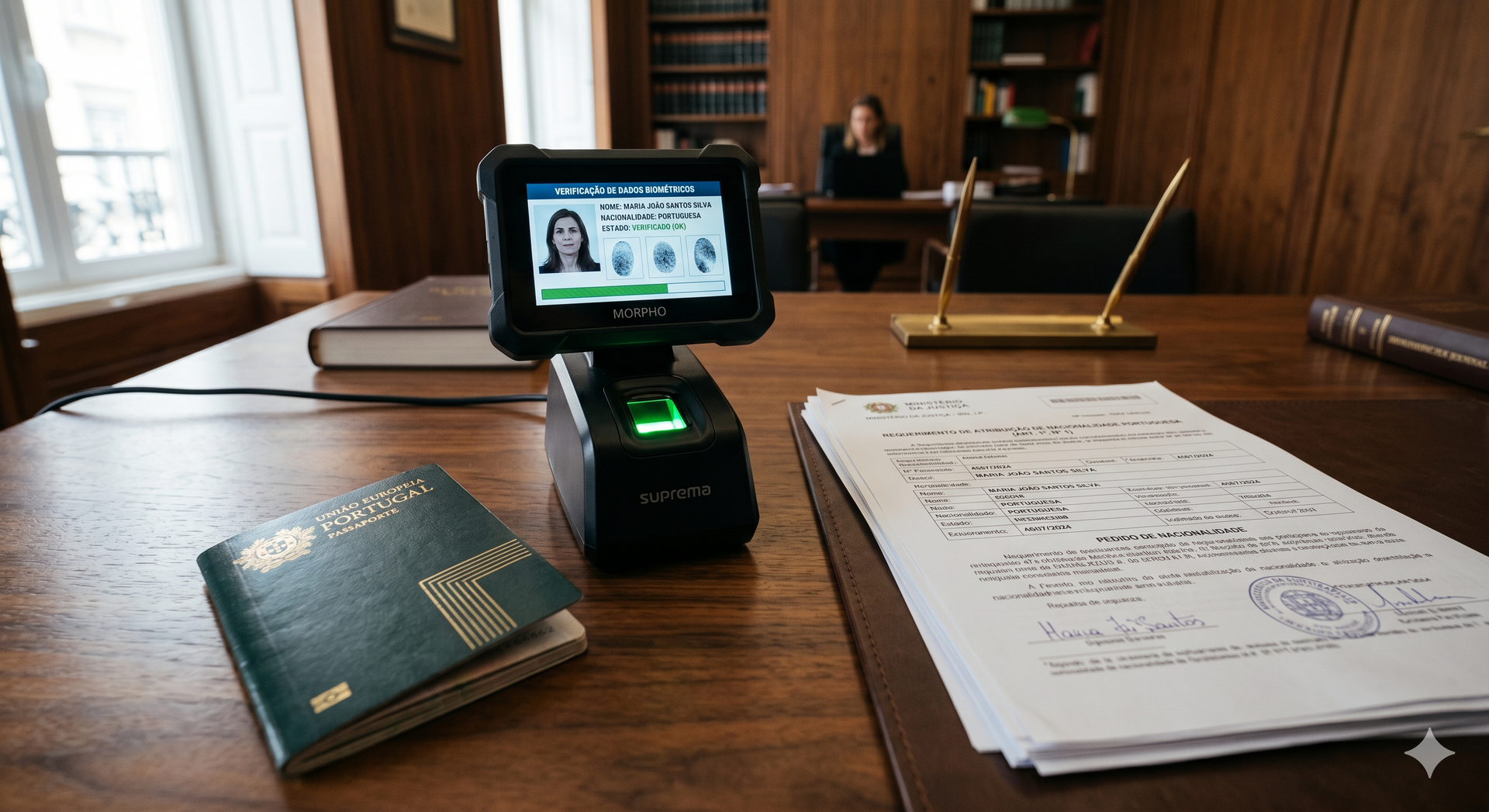
26. Will nationality applicants now have biometric data collected?
Yes.
The new law expressly provides for the collection of biometric data including:
- facial image;
- fingerprints;
- and height.
This data may be used for identity verification and for checking compliance with the legal requirements.
27. Can people challenge this law in court?
Potentially yes.
We expect significant legal debate regarding:
- proportionality;
- legitimate expectations;
- administrative delays;
- constitutional principles;
- the practical impact on long-term residents;
- and the implementation of the new requirements.
It is very possible that aspects of the reform will eventually be litigated before Portuguese courts.
28. Can the law still change again?
Yes.
Immigration and nationality legislation can always be amended again in the future.
Portugal has already changed its nationality framework multiple times over recent years.
This is why legal planning in immigration and nationality matters should always take timing, documentation and legislative risk into account.
29. Is everything already fully regulated and clarified?
No.
This is extremely important.
Although the law is already in force, the Portuguese Government still has 90 days from the publication of the law to publish the updated regulation implementing the recent amendments.
This means that several practical aspects of implementation still require further clarification.
Among other matters, we still do not know:
- how some integration requirements will be assessed;
- whether additional tests or interviews may exist;
- what practical evidence may be required;
- how certain residence periods will be interpreted operationally;
- or how the new requirements will be applied in practice by the authorities.
30. So what should people do now?
Do not panic.
But do not ignore the changes either.
The legal landscape for immigration and nationality in Portugal has become significantly more complex and strategic.
Each case now requires careful individual analysis, particularly for:
- investors;
- Golden Visa holders;
- retirees;
- EU citizens;
- CPLP nationals;
- long-term residents;
- spouses of Portuguese citizens;
- descendants of Portuguese nationals;
- families already living in Portugal;
- and applicants affected by AIMA delays.
Final Thoughts
Portugal remains one of the most attractive countries in Europe for long-term residence, investment and international mobility.
However, the recent reform of the Nationality Law represents one of the most significant changes to Portuguese nationality policy in recent years.
The coming months will likely bring:
- further regulation;
- new practical guidelines;
- legal uncertainty;
- judicial interpretation;
- and potentially significant litigation regarding the implementation of the new regime.
What is already clear is that Portuguese nationality law has entered a new phase, one that appears to place much greater emphasis on integration, cultural connection, civic knowledge, security considerations and demonstrable links to the Portuguese State and community.
For applicants, investors and families connected to Portugal, strategic planning has now become more important than ever.